Our thesis at Eclipse is simple: General-purpose robotics is not just an AI problem. It's a systems problem. And the teams that figure out how to solve these problems are the teams that control the entire system.
Genesis is exactly that kind of team. By building simulation, data, intelligence, and hardware as an integrated system from day one, they’ve been able to achieve remarkable progress in a little over a year toward their mission of building the world’s first truly general purpose robot. Eclipse is proud to be investing in Genesis’ $500 million Series A, after co-leading their Seed over a year ago.
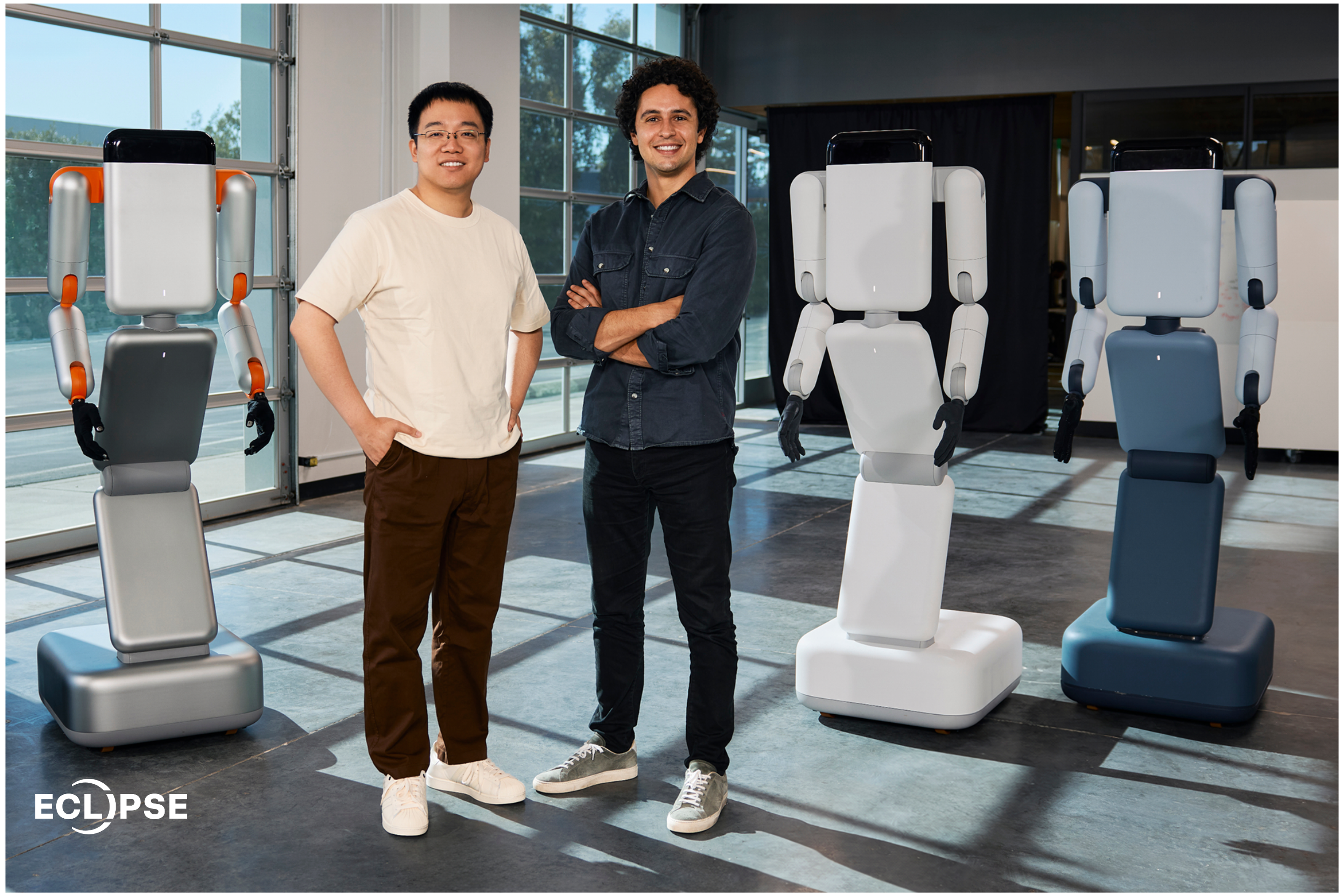
Our conviction in Genesis began when we first met them. Co-founders Zhou Xian and Théophile Gervet stood out for their extraordinary technical depth paired with a fundamentally different approach to scaling robot intelligence. They weren't simply building another foundation model; they were building the infrastructure to make physical intelligence scalable.
They are also a living example of what we at Eclipse have seen work in the real world at scale from our own careers.
I've spent two decades taking machines from prototype to production. At Nissan, Tesla, and Rivian, I helped build some of the world's most advanced manufacturing systems, including launching the Model S, Model X, Model 3, Model Y, R1T, R1S, and Amazon delivery van.
Along the way, I learned two things:
Traditional industrial automation is magnificent but dumb. A welding robot can execute the same weld a million times with extraordinary precision. Ask it to do something different, and it becomes a very expensive statue.
Every new application requires engineering, programming, fixtures, and integration. Automation scales with engineering effort, not intelligence. That's why, after decades of progress, most physical labor remains manual.
My takeaway: The next generation of automation must learn, not be programmed.
Prototypes are easy. Production is hard. I've lived through the manufacturing J-curve at Tesla and Rivian. Cash burns, unexpected failures compound, and the gap between a working prototype and a reliable product can determine whether a company survives.
The hardest problems often emerge at the interfaces: Between software and hardware, simulation and reality, engineering and manufacturing. That’s why owning the entire system is such an advantage. When you control both sides of an interface, you are forced to figure out how to fix problems at the source, and that’s how you learn what compounds.
When Seth Winterroth and I first evaluated Genesis, we started with a question: What must be true for general-purpose robotics to work? From first principles, three things:
1. Solve data scarcity. Language models had the internet. Robots have no equivalent dataset of physical interactions.Collecting robot data is expensive, slow, and difficult to scale. The company that builds the most scalable data engine can learn faster than everyone else.
2. Build intelligence that generalizes. Today's robots are programmed for specific tasks. General-purpose robots must learn skills that transfer across objects, environments, and tasks.That requires world-class foundation models trained on diverse physical interaction data, with simulation enabling evaluation and faster iteration at a scale real-world testing cannot match.
3. Build hardware that can execute the intelligence. A model that understands how to crack an egg is useless if the hand cannot sense and control its grip.
Hardware determines what a robot can learn, what it can do, and ultimately what it costs to deploy. A robot only matters economically when it performs useful work reliably, shift after shift, at a cost below the alternative.
These three problems are inseparable: Intelligence without capable hardware is useless. Hardware without intelligence is just a machine. Neither scales without data.
The conventional wisdom is to specialize. Build the best foundation model, let others build the robots, and become the Android of robotics.
That’s a reasonable strategy in a mature industry. But robotics is not a mature industry.
There are no standard robotic hands, bodies, sensors, data interfaces, or foundation-model architectures. The critical interfaces are still being invented.
When the components are tightly coupled and the interfaces are immature, optimizing individual parts is not enough. You have to optimize the entire system.
Vertical integration is not the goal. It is the necessary strategy for solving a problem whose interfaces have yet to be defined.
Apple understood this in smartphones. Tesla understood it in electric vehicles. Genesis understands it in robotics.
While we were impressed with Genesis from the outset, we underestimated their speed. In a little over a year, they've built four tightly integrated capabilities:
Simulation - Genesis World. A proprietary physics simulation engine originating from research led by Zhou with contributors across 18 research institutions. It enables robots to train and encounter physical scenarios at a scale impossible to replicate in the real world.
Data - Genesis Data Foundry. A sensor glove captures hand motion and touch during real work, and Genesis's robotic hand is designed to closely match the human hand so that human motion can transfer more directly. Together with egocentric video, this helps robots learn from the skills people already use on the job.
Plus, that data engine doesn't just train the robots; it also creates the market for them. Through Genesis Data Foundry partnerships, industrial companies can begin collecting data in their own environments before deploying robots, so Genesis is able to learn customer's tasks, objects, and operating conditions while building relationships with future deployment partners. The partnership with LG CNS is a test case for this strategy: Identifying applications, testing and validating robots in manufacturing and logistics environments, and developing pathways to wider rollout.
Intelligence - GENE: A robotics-native foundation model that performs tasks across cooking, wire harnessing, and lab pipetting autonomously at real speed, using one set of shared weights. For most of the challenging skills shown, it required less than an hour of task-specific robot data.
Hardware - Eno. A purpose-built, wheeled robot with human-like dexterous hands. Rather than copying the human form, Genesis is engineering the robot around useful work, reliability, and deployment economics.
Real-world data improves the model. Simulation accelerates learning. Hardware turns intelligence into productive work. Every deployment generates more data.
Any one of these capabilities could support a company. Genesis is building all four, and together they create something far more powerful: A compounding intelligence flywheel.
Genesis has moved from a bold technical thesis to working systems in an extraordinarily short period.
What gives me conviction is not any single demonstration. It's the combination of technical depth, execution velocity, and the team's obsessive attention to detail.
Zhou and Théo have assembled an exceptional group of researchers and engineers who challenge assumptions, move quickly, and build across disciplines.They have the agency to attack problems others consider impossible.
The $500 million Series A gives Genesis the capital to advance the full system: simulation, data, models, hardware, and manufacturing.
And this matters: Underfunding a vertically integrated robotics company can force compromises at precisely the moment when its components need to mature together. Capital alone doesn't solve engineering problems. But sufficient capital, deployed by an exceptional team, creates the opportunity to solve them without compromising the architecture.
The next challenge is moving from impressive demonstrations to thousands of robots doing productive work. I watched this transition at Tesla and Rivian, and I see it beginning to happen across the Eclipse portfolio today.
It will be hard. Making robots reliable in real work, bringing costs down, ramping production, and converting data partnerships into scaled deployments are real challenges, and there may be moments when the skeptics appear right.
The difference between a great prototype and a great company is the ability to work through that J-curve. That requires technical excellence, manufacturing discipline, sufficient capital, and a team that owns the outcome. Genesis has assembled the foundations for all four. Now comes the test of scaling them.
Genesis is building general-purpose robots for the world’s economy, with a mission to remove the physical limits on human ambition. That means helping people and businesses build more of what they imagine.
And we intend to be there as they bring it to the world.
Congratulations to Zhou, Théo, and the entire Genesis team.
More on today’s news from Bloomberg